pH
Monday, September 28, 2026
pH:
What Your Number Actually Means and What to Do About It
If you've been following along with my work for any length of time, you know I'm not big on chasing symptoms or treating diseases by name. We clean and nourish the system that's affected, then let the body do its job.
This post walks through what your pH number actually means across your whole body, why your body wants it sitting at 6.40 specifically, how calcium drives everything about this number, the five symptom patterns that show up when urine and saliva disagree with each other, and exactly what to do for each one including which herbs help get digestion back on track so the rest of the system can start catching up.
This blog is for informational purposes only and is not intended to diagnose, treat, cure, or prescribe for any condition. It is not a substitute for professional medical advice.
I want to be clear that we're working in a different realm here. We're looking at a number that nobody else measures, and we're seeing how that specific number affects the whole body in distinct ways. Some of the terms I use may sound like the major terms doctors use, but they are not.
Remember, we are not measuring the medical pH that doctors look at when they're checking for acid reflux or stomach acidity. We're measuring the electrical resistance between two opposing forces in your body — the cations and the anions — and how that resistance shows up in your urine and saliva. This affects how your digestive enzymes work, how your liver processes what you eat, and how calcium moves through your system. So when we talk about pH here, we are not talking about what the medical industry measures.
The Quick Version
When your pH number is off, here's what's happening in your body in plain language:
Your body wants its number at 6.40. That's not the same as neutral on the standard 0-14 chemistry scale, where 7.00 is the midpoint. 6.40 is your ideal biologic pH, the line of least resistance where your body's electrical resistance is balanced, not too much friction, not too little. Every cell in your body runs best when the chemistry sits there. When it drifts away from 6.40 in either direction, things start breaking down before you feel anything wrong.
Calcium regulates your pH, both urine and saliva.
Calcium, the calcium in your diet and the calcium reserve already in your body, is what governs your pH overall. Your urine pH shows this most directly. It's the endpoint, the calcium that's already been absorbed and processed, moving out of your system. When calcium is missing or out of balance, your urine number drifts away from 6.40. When calcium comes back into balance, your number comes back toward 6.40. Calcium isn't just one thing either, there are seven different types that affect your chemistry in three different directions.
Iron and B-12 control how available that calcium is, and that's what saliva pH is showing you.
Your saliva pH is still a calcium number underneath, but it's asking a different question than urine pH does. It's not asking how much calcium you have, it's asking whether that calcium can actually get absorbed and put to use. That's where iron and B-12 come in. They don't add calcium, they change its availability, and that's the only way the saliva number actually moves. This is why taking more calcium on its own has never been shown to change the mouth pH. Calcium is still the thing being regulated, but iron and B-12 are what let your body get to it. They do this by making oxygen delivery possible, since they're what your hemoglobin needs to carry oxygen to your cells. When oxygen delivery slows down, the liver can't pick up the calcium it needs, even if there's plenty of calcium available, and that's what shows up as a drifting saliva number.
This is also why your sugar reading matters for saliva pH. When sugar is out of range, it throws off oxygen levels, and oxygen is what makes calcium absorption possible. So a bad sugar number can wreck your saliva pH even when your calcium is fine. And this is the important part: you can't fix saliva pH by just taking more calcium. The calcium isn't the problem, the absorption is. The only way to move saliva pH is to get oxygen levels back in range so the calcium you already have can actually be picked up and used.
This is why the liver matters more than almost anything else in this picture.
Everything you just read runs through one organ. Your liver can't do its job without six things: water, oxygen, calcium, iron, iodine, and vitamin A. Take away any one of them and the liver can't build the digestive enzymes your body needs, can't pick up and deliver calcium where it's supposed to go, and can't keep your chemistry anywhere near 6.40. This is why urine pH and saliva pH aren't really about urine or saliva at all. They're a window into whether your liver has what it needs to function.
And you can already see most of these six in the numbers we've covered. Calcium is the constant underneath both readings — it shows up directly in your urine pH, and in your saliva pH it's the thing whose availability is being tested. Oxygen shows up in your saliva pH and gets pulled off course by your sugar number. Iron and B-12 show up in your saliva pH too, since they're what make that oxygen usable in the first place, and by extension what make your calcium usable but the direction matters. When saliva pH runs at 6.4 or below, that's the body failing to pick up iron, and B-12 is what's needed to help absorb it. When it's paired with other numbers being out of range too, that's a severe pattern touching vitamin A, iron, and B-12 all at once. When saliva pH runs above 6.4 instead, it's a different problem: resistance is too high and energy movement has slowed down, not a sign you simply need more iron. Vitamin A plays one more role beyond this. Alongside iron and iodine, it's part of the liver's basic cellular structure, what lets the liver replace its own cells and keep building the amino acids and enzymes the rest of your body depends on. Water is the one we haven't touched yet, that comes when we get to your salt number, which is where you'll see how well you're actually hydrating.
When one of these six is missing or low, the liver falls behind, and that's when you start seeing the drift.
When the urine and saliva pH drift from 6.4
Your electrical resistance is what's actually shifting.
Your pH reading is a measure of electrical resistance in your body's fluids. 6.40 is the point where that resistance is exactly right, the point that produces the best electrical flow and magnetism for picking up minerals, building liver enzymes, and building tissue. When you drift off 6.40, that resistance changes, and your whole energy frequency shifts with it. That's the real reason mineral utilization starts failing before you feel anything.
Your digestion speed drifts.
When your number climbs above 6.40, electrical flow slows down because there's too much resistance, and digestion slows down with it, tending toward constipation, heaviness after eating, and sluggish gut motility. When it drops below 6.40, there's too little resistance, so electrical flow and friction speed up, and digestion rushes, tending toward diarrhea and nutrients passing through before they can be absorbed. Either way, your digestive enzymes aren't working at full strength because they need that 6.40 resistance to function properly.
Your liver loses its building materials.
Your liver creates most of your digestive enzymes based on signals from your brain about what food is coming in, and it depends on calcium more than anything else to give those enzymes their strength and buffering. When pH drifts, the liver isn't getting the mineral energy it needs, so those enzymes get built wrong or shipped out half-finished, and your body can't properly link up new cells, amino acids, or DNA building blocks. The whole digestive chain breaks down before any traditional symptom shows up in how you feel after meals.
Oxygen and hydrogen fall out of balance.
Drifting off 6.40 throws off your cells' oxidation-reduction balance, which is the exchange of oxygen and hydrogen pressure inside your cells. Go too far one way and that exchange runs too fast, breaking cells apart faster than they can hold their structure. Go too far the other way and it runs too slow, congesting your cells with minerals that never get used and dead cellular debris that never gets cleared.
Free radicals start building up.
Every time your pH drifts away from Range A, these misfiring oxidation-reduction reactions throw off extra free radicals. That's what turns into cell injury, tissue inflammation, and degenerative disease over time if it isn't corrected.
Your energy swings based on direction.
High pH people tend toward sluggishness, weight gain, congestion, and fluid retention, along with that thickened, heavy feeling in the tissues. Low pH people tend toward nervousness, anxiety, feeling wired but tired, burnout, and weight loss, along with more friction, heat, and physical irritation as tissue breaks down faster than it can rebuild. Both directions put stress on collagen, the cement holding your cells together, but vitamin C plays a different role depending on which way you've drifted, and it's not just about how much you need, it's about whether your body can actually use it. On the low, cationic side, vitamin C deficiency runs severe, and your body genuinely needs it, but it can't make use of vitamin C in the usual supplement forms while pH is that low. On the high, anionic side, it's the opposite: your body both needs it and can actually use it, which is why megadoses of vitamin C are used there to add cations back in and help bring the pH down.
Both directions drain your reserve and let waste build up.
Whichever way you drift, your digestive enzymes can't pull energy out of food properly, so your cells run on fumes, which shows up as brain fog and chronic fatigue. Misregulated calcium starts showing up in two places at once, deposits and calcifications forming in some areas while bone and joints get robbed of calcium in others. And the buildup of free radicals means slower healing and faster aging on top of everything else.
Why 6.40 Is Where Your Body Wants Its Number
Seven is neutral. 6.40 is yours.
The pH scale runs from 0 to 14. Seven is neutral on a chemistry bench. But your body doesn't run on a chemistry bench, and 6.40 isn't chemistry's neutral point, it's yours.
6.40 is the literal midpoint of your range.
The human urine and saliva pH range runs from a low of 4.80 to a high of 8.00. Split that range down the middle and you land exactly on 6.40. That's not a rounded-off estimate, it's the literal midpoint of what your body can survive at, which is why it's the balance point your chemistry is built around.
It's the point of least electrical resistance.
pH isn't just a number on a scale, it's a measure of electrical resistance between two opposing forces in your body, cations and anions. At 6.40, that resistance is calibrated exactly right, giving you the best line of least resistance for moving energy through your system without wasting any of it. When your number climbs above 6.40, there's too much resistance and everything slows down. Digestion drags, and your body can't move toxins out efficiently. When your number drops below 6.40, there's too little resistance and everything moves too fast, burning through your system without doing the work it needs to do. Your cells can't hold onto what they're supposed to hold onto.
It sets your magnetism, and magnetism moves your minerals.
Electrical flow and resistance together create a magnetic pull, and at 6.40, that pull is strong enough to grab raw mineral energy, carry it into the liver, and build it into complete enzymes and tissue. Move off 6.40 and that magnetic field distorts, so minerals stop bonding the way they're supposed to, no matter how much of them you're taking in.
It balances your anions against your cations.
6.40 is where your anions and cations sit in the right ratio to each other, calcium, potassium, and chlorine on the anionic side, and nearly every food you eat on the cationic side. That ratio matters because your digestive enzymes are anionic, and they need cationic food to arrive with exactly the right amount of resistance in order to break it down and release usable energy from it.
It sets your digestion at the right speed.
That same balance point keeps your cells the right shape and your fluids the right thickness, which is what lets food move through your digestive tract at the speed it needs to for you to actually absorb the nutrients in it, not so slow that you're constipated, not so fast that it's through you before your body can use it.
It keeps free radicals from spiking.
6.40 is what keeps your cells breathing evenly, balancing the oxygen and hydrogen pressure moving in and out of them. That balance is what keeps toxic free radicals from spiking. Drift off 6.40 in either direction and that spike happens anyway, which is what starts wearing down tissue and aging your cells faster than they should.
Think of it like a river.
Dam it up too much and nothing moves. Take the dam away completely and everything rushes past without depositing anything where it's supposed to go. 6.40 is the exact flow rate where everything gets done that needs to get done.
This isn't unique to you, it's biology.
Nearly all biological life runs best at this same resistance point, not just humans. So when we say your body wants its number at 6.40, we're not making that up to sound good. We're describing what biological systems actually need in order to function.
Calcium Runs Everything About This Number
Your pH number is really a calcium story. The calcium in your diet and the calcium reserve already in your body dictates what your pH does. When calcium is missing or out of balance, your number drifts away from 6.40. When calcium comes back into proper balance, your number comes back toward 6.40.
This is why calcium supplementation matters so much, especially given how poor modern food quality has become. The food most people eat today doesn't carry enough usable calcium to keep the system balanced, so it has to be added back in deliberately.
But calcium isn't just one thing. There are seven different types of calcium that affect your chemistry in three different directions:
Cationic calciums (push your number down, toward acid):
- Phosphate of Calcium (Dicalcium Phosphate, Calcium Phosphate)
- Sulfate of Calcium (Calcium Sulfate, Calcium Lactate)
- Sour Milk Calcium (Acidophilus Milk, Buttermilk)
- Ascorbate Calcium
Neutral calciums (don't push strongly in either direction):
- Natural Mineral Colloids (Mincol)
- Gluconate Calcium (Calcium Gluconate)
- Sweet Milk Calcium (Skimmed Milk Powder, Yogurt)
- Orotate Calcium
Anionic calciums (push your number up, toward alkaline):
- Carbonate of Calcium (Coral Calcium, Tums)
- Oxide of Calcium (Calcium Hydroxide, Reams' Cal II, Lime Water)
- Carbonate of Calcium & Magnesium (Dolomite)
- Tri-Calcium (Sodium Bicarbonate)
- Citrate Calcium (Calcium Citrate)
Gluconate calcium or milk calcium is the baseline used across all pH ranges, since the two are comparable and interchangeable depending on what you can find. From there, the other calciums are added in ratio with the gluconate to move your number in whichever direction it needs to go.
After working with a lot of these directly, I ended up making my own acidic and alkaline calcium, because in practice they moved the number better than the individual forms above did on their own. That's what I actually reach for now: an acidic calcium to bring a high number down, and an alkaline calcium to bring a low number back up.
Here's the key principle either way: if your number is high, too anionic, you need a cationic, acidic calcium to bring it down. If your number is low, too cationic, you need an anionic, alkaline calcium to bring it up. Using the wrong type makes things worse instead of better.
There's also something important called relative excess versus actual excess.
Picture an old apothecary balance. When weight comes off one side, the other side looks like it has too much, even though nothing was added to it, the other side just doesn't have enough anymore. This is why calcium can appear to be in excess in some degenerative states, like arthritis, gallstones, or kidney stones, while there's actually an overall calcium deficiency driving the whole problem.
How to Test Your pH Number
Testing pH is simpler than testing sugars because you're not doing math corrections, you're just matching a color.
You'll test both urine and saliva because they tell you different things. Saliva pH tells you what's happening as food goes in, it's a measure of liver strength and the digestive enzymes being produced. Urine pH tells you what happened after digestion completed, it's the outcome of what the liver's function produced.
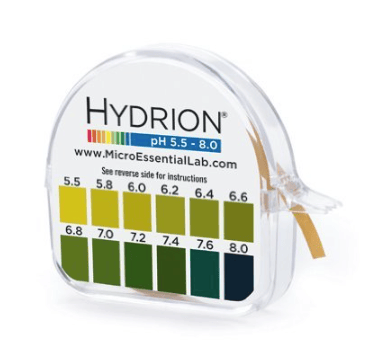
Testing saliva pH. Tear off about an inch of pH strip. Fill your mouth with saliva under your tongue, then dip the strip in it. Within about 30 seconds of dipping, match the strip's color against the scale on the box and write down the number that's the closest match.
Testing urine pH. Tear off a fresh inch of strip. Dip it in your urine, and check it against the color scale immediately, within about 30 seconds of dipping. Write down that number too.
Once you have both numbers, you'll calculate a weighted average, since saliva carries twice the value of urine in overall energy effect:
(Urine pH + 2 × Saliva pH) ÷ 3 = Average pH
If your average is above 6.40, your chemistry is tending anionic, alkaline. If it's below 6.40, it's tending cationic, acid.
How to move the pH toward 6.4
What This Chart Is Based On
Earlier, I went through the different forms of calcium and which direction each one tends to push the pH. Any of those can be used, and plenty of options can be found online. But over many years of working with clients, I could not find anything on the market that moved the numbers consistently enough or fast enough. So I formulated my own alkaline calcium and acidic calcium. The starting points and adjustments here are based on those two, because they are the ones I have watched move the numbers accurately. The other forms can be started the same way and then adjusted from there.
The same goes for iron and B-12. For iron, I use Ionic Liquid Iron Supplement because a large amount can be taken without constipation, which matters when the numbers call for a lot. For B-12, I use BioActive Vitamin B12 5000mcg, an activated form. In my experience, B-12 is very inefficient to absorb, with or without an MTHFR variation. The activated form is usually the only one that works, and sometimes even that isn't enough. Both are the least expensive options I have found that still get the job done.
Typical Starting Points by pH Range
This is an educational guide, not a prescription. When urine and saliva pH fall in a given range, these are the amounts a starting point typically lands on, and where the pH readings would most likely begin to move back toward 6.4. One reading runs down the left side and the other across the top. These are best estimates meant to bring the numbers as close to 6.4 as possible, and individual results vary. How those amounts get adjusted after a retest comes in the next section.
Calcium: urine pH (down) and saliva pH (across)
Urine below 6.4 points toward alkaline calcium. Urine above 6.4 points toward acidic calcium. Amounts are in capsules. A dash means that row doesn't apply.
| Urine pH ↓ / Saliva pH → | 4.8 | 5.5 | 5.8 | 6.0 | 6.2 | 6.4 | 6.6 | 6.8 | 7.0 | 7.2 | 7.4 | 7.6 | 8.0 |
|---|---|---|---|---|---|---|---|---|---|---|---|---|---|
| 4.8 | 12 | 11 | 10 | 10 | 9 | 9 | 8 | 8 | 7 | 6 | 5 | 5 | 3 |
| 5.5 | 7 | 6 | 6 | 5 | 5 | 5 | 5 | 4 | 4 | 3 | 3 | 3 | 2 |
| 5.8 | 5 | 4 | 4 | 4 | 4 | 3 | 3 | 3 | 3 | 2 | 2 | 2 | 1 |
| 6.0 | 3 | 3 | 3 | 2 | 2 | 2 | 2 | 2 | 2 | 2 | 1 | 1 | 1 |
| 6.2 | 2 | 1 | 1 | 1 | 1 | 1 | 1 | 1 | 1 | 1 | 1 | 1 | 0 |
| 6.4 | – | – | – | – | – | – | – | – | – | – | – | – | – |
| 6.6 | 0 | 0 | 0 | 0 | 0 | 1 | 1 | 1 | 1 | 1 | 1 | 1 | 1 |
| 6.8 | 0 | 1 | 1 | 1 | 1 | 1 | 1 | 1 | 1 | 1 | 1 | 1 | 2 |
| 7.0 | 0 | 1 | 1 | 1 | 1 | 2 | 2 | 2 | 2 | 2 | 2 | 2 | 2 |
| 7.2 | 1 | 1 | 1 | 2 | 2 | 2 | 2 | 2 | 2 | 3 | 3 | 3 | 3 |
| 7.4 | 1 | 1 | 2 | 2 | 2 | 3 | 3 | 3 | 3 | 3 | 3 | 3 | 4 |
| 7.6 | 1 | 2 | 2 | 2 | 3 | 3 | 3 | 3 | 4 | 4 | 4 | 4 | 5 |
| 8.0 | 1 | 2 | 3 | 3 | 4 | 4 | 4 | 5 | 5 | 5 | 5 | 6 | 6 |
B-12 and iron: saliva pH (down) and urine pH (across)
Saliva below 6.4 points toward B-12 (in mcg). Saliva above 6.4 points toward iron (in mg).
| Saliva pH ↓ / Urine pH → | 4.8 | 5.5 | 5.8 | 6.0 | 6.2 | 6.4 | 6.6 | 6.8 | 7.0 | 7.2 | 7.4 | 7.6 | 8.0 |
|---|---|---|---|---|---|---|---|---|---|---|---|---|---|
| 4.8 | 20,000 | 18,900 | 18,400 | 18,100 | 17,800 | 17,500 | 17,200 | 16,900 | 16,600 | 16,300 | 15,900 | 15,600 | 15,000 |
| 5.5 | 11,300 | 10,600 | 10,400 | 10,200 | 10,000 | 9,800 | 9,700 | 9,500 | 9,300 | 9,100 | 9,000 | 8,800 | 8,400 |
| 5.8 | 7,500 | 7,100 | 6,900 | 6,800 | 6,700 | 6,600 | 6,400 | 6,300 | 6,200 | 6,100 | 6,000 | 5,900 | 5,600 |
| 6.0 | 5,000 | 4,700 | 4,600 | 4,500 | 4,500 | 4,400 | 4,300 | 4,200 | 4,100 | 4,100 | 4,000 | 3,900 | 3,800 |
| 6.2 | 2,500 | 2,400 | 2,300 | 2,300 | 2,200 | 2,200 | 2,100 | 2,100 | 2,100 | 2,000 | 2,000 | 2,000 | 1,900 |
| 6.4 | – | – | – | – | – | – | – | – | – | – | – | – | – |
| 6.6 | 3 | 3 | 3 | 3 | 4 | 4 | 4 | 4 | 4 | 4 | 5 | 5 | 5 |
| 6.8 | 5 | 6 | 7 | 7 | 7 | 8 | 8 | 8 | 8 | 9 | 9 | 9 | 10 |
| 7.0 | 8 | 9 | 10 | 10 | 11 | 11 | 12 | 12 | 13 | 13 | 14 | 14 | 15 |
| 7.2 | 10 | 12 | 13 | 14 | 14 | 15 | 16 | 16 | 17 | 18 | 18 | 19 | 20 |
| 7.4 | 13 | 15 | 16 | 17 | 18 | 19 | 20 | 20 | 21 | 22 | 23 | 23 | 25 |
| 7.6 | 15 | 18 | 20 | 21 | 22 | 23 | 23 | 24 | 25 | 26 | 27 | 28 | 30 |
| 8.0 | 20 | 24 | 26 | 28 | 29 | 30 | 31 | 33 | 34 | 35 | 36 | 38 | 40 |
Where Would a Starting Point Fall?
Enter a urine and saliva pH to see where a typical starting point falls for numbers in that range, and what would most likely move them back toward 6.4.
Weekly Adjustment Guide
After a week at the starting amounts, the weekly average is compared with 6.4. The farther the average still sits from 6.4, the larger the typical adjustment. An average that did not move at all calls for an aggressive adjustment, an average that moved most of the way calls for a small one, and an average that landed on 6.4 calls for none.
| Weekly average is this far from 6.4 (in the direction being corrected) | Typical change to the current amount |
|---|---|
| 0 (on target) | no change |
| 0.2 | +10% |
| 0.4 | +20% |
| 0.6 | +30% |
| 0.8 | +40% |
| 1.0 | +50% |
| 1.2 | +60% |
| 1.4 | +70% |
| 1.6 (did not move from the extreme) | +80% |
Weekly Adjustment Calculator
Enter the average urine pH and the average saliva pH, along with the amounts being taken now. A weekly average moves the numbers most accurately and is the recommended way to use this. A single day's readings can be entered too, but adjusting off daily readings tends to swing widely.
Average pH readingsThe Five Symptom Patterns
Here's where this gets practical. When urine and saliva disagree with each other when one is high and one is low, or both are off in different directions there are distinct patterns that show up. Each one has its own symptom profile and its own approach.
The Stages of Mineral Loss
The four patterns aren't random. At the ideal, both urine and saliva sit at 6.4 and the minerals are in optimum supply. As minerals begin to be lost, the readings step away from 6.4 in a predictable sequence.
- Pattern 1 urine and saliva pH above 6.4
- Pattern 2 urine pH below 6.4 saliva above 6.4
- Pattern 3 urine pH above 6.4 saliva below 6.4
- Pattern 4 both urine and saliva pH below 6.4
Urine follows the calcium. In the first stage, the body loses acidic calcium, so the urine climbs above 6.4. In the second stage, alkaline calcium is lost and the urine drops below 6.4. In the third stage, more acidic calcium is lost and the urine climbs above 6.4 again. In the fourth stage, more alkaline calcium is lost and the urine drops below 6.4 again. This back-and-forth is what the progressive breakdown of minerals looks like.
Saliva follows iron, and then B-12. In the first two stages, saliva reads above 6.4 because iron is being lost, and the body can use iron directly, so iron is what brings the reading back down. In the last two stages, saliva reads below 6.4. Iron is still needed, since the saliva pH is always showing that need, but it can't be used yet until enough B-12 is available to absorb it. That is why B-12 comes first in those stages. As B-12 builds, the iron becomes usable and the saliva climbs back toward 6.4.
Reading the two numbers together shows roughly how far along the mineral loss is, which is also why the amounts in the charts differ from one pattern to the next.
Start Here for Every Pattern: Digestion First
Whichever pattern shows up, digestion is where I start. When the numbers are this far off, the digestive system is usually weak and working against everything else. The first stage is getting it working again so food can actually be used, which sets the stage for everything that follows. Three formulas cover this. Two are used together every time, and the third is used only as needed.
Colon Restore supports the strength of the digestive system. If someone were going to begin somewhere without looking at any other symptoms, this is where I would start. The usual amount is 3 capsules a day, and the timing doesn't matter.
Colon Ease is there for comfort. It supports the digestive tract with fibers that encourage healthy flora to regrow, and it makes the whole cleaning and healing process more comfortable, including moving waste out more comfortably. The usual amount is 2 capsules, three times a day, and the timing doesn't matter here either.
Colon Move is the one used to move the bowels, and it is dosed by how they are moving. When they are not moving one to three times a day, I start with 3 capsules in the evening, because it works most efficiently overnight. The amount then goes up or down as needed until the bowels are moving one to three times a day.
Pattern 1: Both urine and saliva pH are above 6.4 (Both Anionic)
This means urine is alkaline, saliva is alkaline
This pattern points toward constipation and slow digestion. Your system is overloaded with toxins from normal metabolic waste plus whatever's getting reabsorbed from fecal matter sitting too long in the bowel. Parasites love this environment because there's plenty of "room and board" available.
What you'll likely see:
- Constipation or sluggish bowel movements
- Upper respiratory and sinus congestion
- Lymph congestion
- Prone to lung infections
- Body odors (breath, feet, bowel gas)
- Abdomen becomes more distended with age
- Tendency toward being overweight later in life
- Skin pigmentation issues (this pattern usually means vitamin D is ratioed toward excess)
- Various skin tumors, lesions, boils, cysts
- Excessive tooth decay (especially with poor diet history)
- Women's fingernails splitting, cracking, ridged
- Women's menstrual cycles uncomfortable with excessive bleeding or cramping
- Premenstrual Syndrome potential
- Right side of body tends to be weaker
- Tendency toward curvature of spine to the left
- Vitamin C deficiency
Managing the pH with This Pattern
Someone with both readings high would typically look to acidic calcium for the urine side and iron for the saliva side, since both work to bring the readings back down toward 6.4. Because both readings pull in the same direction, the starting amounts in the charts run higher here than in the mixed patterns. The Typical Starting Points by pH Range charts show where those amounts usually start, and the Weekly Adjustment Guide shows how they typically change after a week. Digestion comes first in every pattern, so the formulas from the Start Here section apply as well. This is educational information about what tends to be used when the numbers look like this, not a prescription.
Pattern 2: urine pH below 6.4 saliva pH above 6.4 (Urine Cationic Saliva Anionic)
This means urine is acidic but saliva is alkaline and there can be a big spread between them.
This pattern still tends toward slow digestion depending on how high the average sits, but with one major addition: a very large spread between urine and saliva means the initial digestive reaction in the stomach is very eruptive.
What you'll likely see:
- All the symptoms from Pattern 1 (since average is still high)
- The further the numbers are apart from each other the more drastic food sensitivities will be
- lots of gas and bloating
- Stomach empties rapidly causing hunger soon after eating
- Lower digestion still slow
- Tendency toward large abdomen ("beer belly")
- Bloating especially after meals
- The large spread between numbers indicates a big difference in potential between food coming into digestion and the digestive enzymes themselves similar to how a massive electrical discharge happens when sperm meets ovum (a natural process), but here it's improper discharge causing cell damage rather than proper fertilization.
Managing the pH with This Pattern
Someone with low urine and high saliva would typically look to alkaline calcium for the urine side and iron for the saliva side. Because the two readings pull against each other, the starting amounts in the charts run lower than when both readings agree. The Typical Starting Points by pH Range charts show where those amounts usually start, and the Weekly Adjustment Guide shows how they typically change after a week. Digestion comes first in every pattern, so the formulas from the Start Here section apply here too. This is educational information, not a prescription.
Pattern 3: urine pH above 6.4 saliva below 6.4 (urine and anionic saliva cationic)
This means urine is alkaline but saliva is acidic and there can be a big spread between them.
What you'll likely see:
- The further the numbers are apart from each other the more drastic food sensitivities will be
- Very eruptive digestion with lots of upper GI gas
- Stomach bloating especially
- Belching
- Hiatal hernia aggravation (especially with long-term high salt intake)
- High amount of energy loss
- Significant weakness if pattern persists
- Elevated stroke risk if pattern persists long-term especially with high salt intake
Managing the pH with This Pattern
Someone with high urine and low saliva would typically look to acidic calcium for the urine side and B-12 for the saliva side. Iron is still needed in this pattern, but it can't be used until enough B-12 is available to absorb it, so B-12 comes first. Because the two readings pull against each other, the starting amounts in the charts run lower than when both readings agree. The Typical Starting Points by pH Range charts show where those amounts usually start, and the Weekly Adjustment Guide shows how they typically change after a week. Digestion comes first in every pattern, so the formulas from the Start Here section apply here too. This is educational information, not a prescription.
Pattern 4: Both urine and saliva pH are below 6.4 (Both Cationic)
This means urine is acidic and saliva is acidic.
This is the exact opposite of Pattern 1. Digestion runs too fast — even to diarrhea when numbers get very acidic.
What you'll likely see:
- Diarrhea or very fast transit time
- Colitis or Crohn's disease tendencies
- Bone mineral loss moving toward osteoporosis
- Deterioration pronounced in bone structure supporting teeth
- Tooth decay itself can be minimal even while periodontal structures give way
- Weakness on left side (opposite of Pattern 1)
- Discomfort in muscles below waist
- Leg cramping
- Joint and bone aches
- Skin rashes
- Dry skin
- Normal to underweight
- Very nervous (especially women)
- Fungus infections (mouth, foot, vaginal yeast)
- Women's menstrual cycles may become scanty
- Early menopause potential
- Severe vitamin C deficiency but unable to take more due to existing acidity
- Severe vitamin D deficiency
- If saliva pH is 6.4 or below with other numbers out of line → need extra vitamin B-12
- Pernicious anemia may show later
- Pale skin color
- Severe potassium deficiency risk (especially if insoluble urea below 12)
Managing the pH with This Pattern
Someone with both readings low would typically look to alkaline calcium for the urine side and B-12 for the saliva side. Iron is still needed here too, but it can't be used until enough B-12 is available to absorb it, so B-12 comes first. Because both readings pull in the same direction, the starting amounts in the charts run higher here than in the mixed patterns. The Typical Starting Points by pH Range charts show where those amounts usually start, and the Weekly Adjustment Guide shows how they typically change after a week. Digestion comes first in every pattern, so the formulas from the Start Here section apply as well. This is educational information, not a prescription.
That's intentional.
One of the biggest things happening across all these patterns is digestion being off. Yes, it's affecting brain function, liver function, heart function, skin all those areas matter and we need to support them moving forward. But one of the main things we need to get running properly first is digestion itself.
Here's why: when digestion breaks down early in any direction, toxins accumulate throughout the system faster than the body can clear them normally. That backup contributes directly to problems showing up everywhere else brain fog from toxin accumulation reaching neural tissue, skin breakouts from toxins being pushed outward as secondary elimination pathway, heart stress from thickened blood viscosity, sleep disruption from temperature regulation breaking down.
Getting bowels moving consistently removes one major source of ongoing toxicity so everything else has room to start catching up.
That's why Colon Move matters even though it can be uncomfortable when pH is high: yes, we need to drive those numbers down toward normal range eventually. But right now we also need those bowels moving because backed-up waste contributes toxicity throughout the rest of the system regardless of which direction your chemistry drifted.
As your pH comes down toward normal range through other work, your bowels will start moving comfortably on their own and you'll need less Colon Move over time. The discomfort isn't permanent It's part of bringing an out-of-balance system back into proper function.
Speed up your progress
If you want help walking through your own numbers or figuring out which pattern fits where you're sitting right now that's exactly what I do with clients every week
You can book a session here
We'll go through all five numbers together and find your best starting point

Hi, I Am Scott James
C.H C.H.S C.N.H.P
I'm a trained herbalist and naturopathic dedicated to sharing everything I've learned through my education and years of real-world experience. This blog is my space to dispense the knowledge I've gained not just from my naturopathic education, but from decades of hands-on study and apprenticeship with my dad, who began working with clients in 1980. Since I was 12 years old in 2001, natural health and healing has been my main course of study—both through homeschooling and professional practice. I've been working with my own clients since 2016, and this blog reflects the culmination of my formal training, professional expertise, and the generational wisdom passed down through my family's commitment to natural health.